Low-carbon heat networks
The City of London Corporation is committed to supporting the Square Mile achieve net zero by 2040. The main challenge for this goal is the decarbonisation of buildings’ heating and cooling systems, with buildings being responsible for 65% of carbon emissions in the Square Mile.
Our Local Area Energy Plan identified heat networks as key to reducing carbon emissions from buildings, by offering a low-carbon solution for both heating and cooling.
Heat networks
Heat networks are large-scale communal heating systems that supply heat from a shared source to multiple buildings in a geographical area. Heated water is circulated through underground insulated pipes, replacing the need for individual gas boilers and increasing overall efficiency.
They can use a range of low-carbon and waste heat sources, including ambient heat from the air, rivers, and ground, as well as excess heat from examples such as London Underground, data centres, and the sewer system.
Heat networks are a practical and cost-effective way to decarbonise heat locally. They make heating cleaner, more efficient, and more affordable, helping to reduce reliance on fossil fuels across the Square Mile.
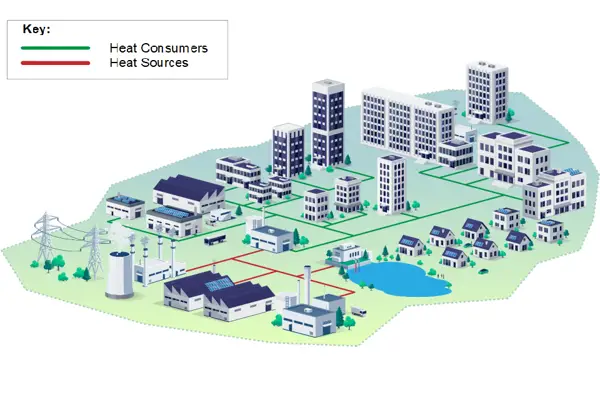
The image illustrates how heat networks can operate within an urban environment.
Heat Network Strategy
The City Corporation is developing a Heat Network Strategy to outline a clear pathway for development and implementation of heat networks across the Square Mile. The strategy will identify where heat networks could be delivered and ensure they can provide the greatest environmental and economic benefits to businesses and residents in the Square Mile.
Preparing for Heat Network Zoning
The UK Government plans to introduce Heat Network Zoning Regulations in 2026, with the ambition that at least a fifth of UK heat will come from heat networks by 2050. Around 3% of UK heat demand is currently supplied by heat networks.
Heat network zoning is the process of identifying and designating areas as heat network zones and then developing heat networks within them. Zoning designates areas where heat networks are expected to provide the lowest-cost, low-carbon heating solution.
Although the regulations will come into force in 2026, full implementation will take several years. To get ahead of this and help shape how heat networks are planned and delivered across the UK, the City Corporation has been one of 22 urban authorities taking part in the Government’s Advanced Zoning Programme (AZP). This early involvement supports faster heat network development ahead of new national zoning regulations.
Early findings for the Square Mile suggest:
- Around 1,200 Square Mile buildings could be required to connect to a future heat network
- These buildings combined heat demand is around 1,000 GWh per year
- Investment of £1bn+ is required to deliver a City-scale network to connect these buildings
Zone boundary consultation
The Square Mile has the highest density heat demand in the UK and has been identified as a place where heat networks are expected to provide the lowest-cost, low carbon heating option.
The City Corporation is seeking to designate the whole of the Square Mile area as a heat network zone and is holding a public consultation to gather feedback on the proposed zone boundary,
Heat network development
The Square Mile already has one operating heat network, and the City Corporation is exploring opportunities for future networks.
Citigen
The Citigen network, operated by E.ON, is currently the only existing heat network in the Square Mile. Options to expand and decarbonise the network have been explored, and E.ON continues to develop these plans in line with forthcoming Heat Network Zoning Regulations.
Central and Western Square Mile area
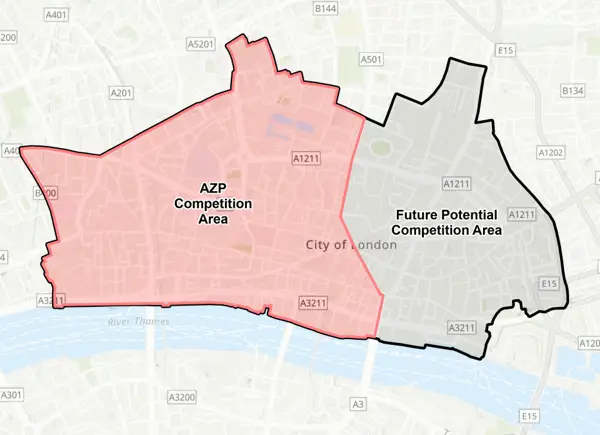
The City Corporation is running a tender to appoint a Heat Network Development Partner for the central and western parts of the Square Mile. The Partner is expected to be appointed in November 2026, and will be responsible for designing, funding, building, and operating the network. This procurement is part of the City Corporation’s participation in the Government's Advanced Zoning Programme (AZP). The image below shows the AZP competition area for this tender, and the eastern Square Mile which may form part of a future competition area.
North-East Square Mile study
The City Corporation carried out a study in 2024 (supported by the GLA and in collaboration with Hackney and Tower Hamlets) to propose options for developing a new low carbon heat network within the North-East of the Square Mile. The proposed heat network is currently indicative, and there is no planned construction programme for its delivery – however, this area has the highest heat density in the Square Mile and is a high priority for future heat network development.
For more information about the City Corporation’s Heat Network Programme, contact the Energy Planning Team.