History of the House
First residents
Wentworth Place was built from 1814 to 1816 by William Woods, a local Hampstead builder. It was originally two semi-detached homes designed to look like one, and had a shared garden. Charles Wentworth Dilke and his family were the first occupants of the larger half of the house, while the smaller, eastern half was occupied by Dilke's friend Charles Brown. Keats and his brothers had become friends with them after they moved into lodgings in nearby Well Walk. Brown invited Keats to share his half of Wentworth Place in December 1818 after the death of his younger brother Tom. It was here that he fell in love with his neighbour, Fanny Brawne. Keats left the house in September 1820 suffering from tuberculosis and travelled to Italy with his friend Joseph Severn. Keats died in Rome in February 1821.
The Brawne family continued to live in the house until the early 1830s. Keats's sister Fanny and her family moved into the other half of Wentworth Place in 1828. They also left the house in the early 1830s.
Eliza Jane Chester moves in
Eliza Jane Chester was a retired actor notable for lead roles in comedies and a favourite of George IV. In 1838 she opened up the dividing walls to create a single home. She also added a large room with a conservatory at the eastern end of the house (the Chester Room) for entertaining guests.
From Wentworth Place to Lawn Bank
The house continued to be a private residence, and briefly a school, until the early years of the 20th century. Some notable residents of the house were William Henry Stiel, a composer, the artist Henry Selous, Charles Cadby a piano manufacturer, and the physiologist Dr William Sharpey. The house had several changes of name, including Lawn Cottage, Laurel Cottage, and until 1925, Lawn Bank.
Rediscovering Keats
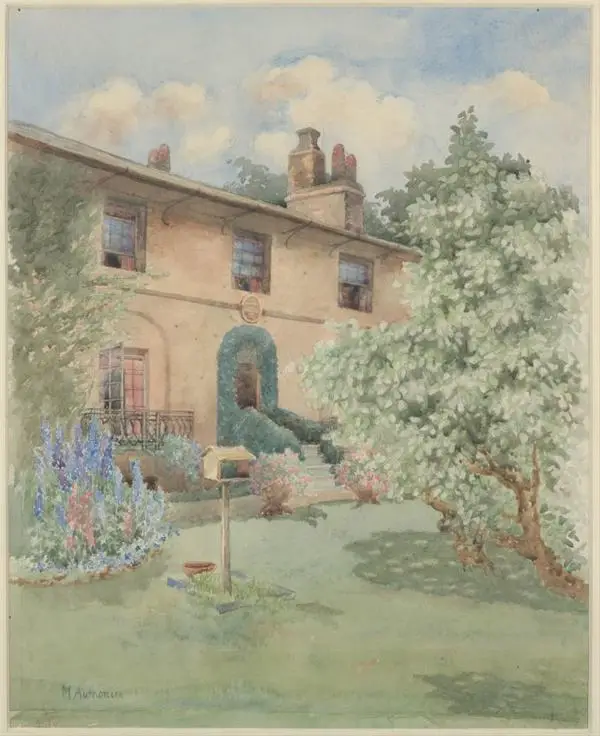
In 1847 William Howitt published 'Homes and Haunts of the Most Eminent British Poets', but because of Miss Chester's alterations and the change of name, he was unable to identify which house Keats had lived in, and he assumed it was no longer in existence. Richard Monckton Milnes published 'The Life, Letters, and Literary Remains of John Keats' in 1848, and increased interest in Keats's life and work dates from this time.
A search began for the location of Keats's 'Wentworth Place', and In 1878 Harry Buxton Forman identified the house in 'The Locality of Wentworth Place', published as an appendix to his edition of Keats's letters to Fanny Brawne.
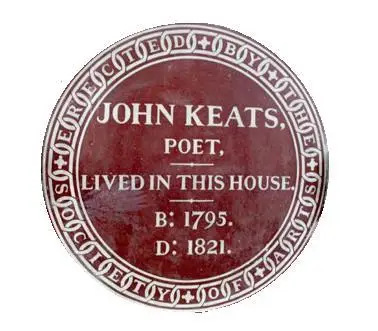
A Royal Society of Arts plaque commemorating Keats's residence was installed on the front of the house in February 1896.
Keats's home under threat
In 1920, when the house was under threat of being sold and redeveloped, a Committee was formed to save it. After a successful fundraising effort in Britain and the United States, the property was acquired on 24th March 1921.
In 1921 the Committee published 'The John Keats Memorial Volume' to help raise funds.
Read 'The John Keats Memorial Volume.'
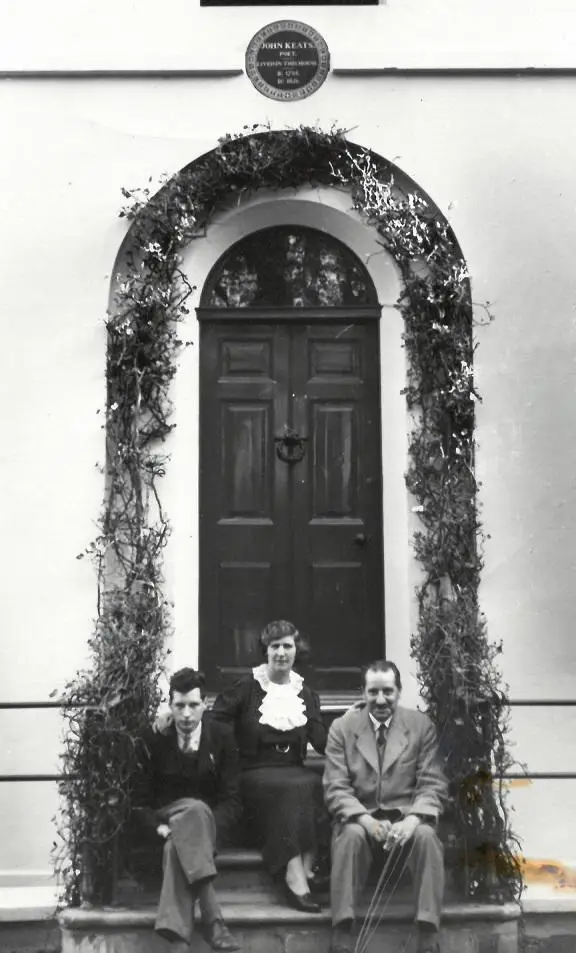
In April 1922, the Committee offered the house to Hampstead Borough Council. After redecoration and repairs, the house opened to the public on 9 May 1925. An address was given by local resident Sir Arthur Quiller-Couch.
Read Sir Arthur Quiller-Couch's address.
The first curator was Fred Edgcumbe, who lived in the house with his family. In 1926 the first guidebook was published. You can view a short film about Keats House made around that time, at Film London.
Keats House as a museum
On 17th July 1931 the Keats Museum and library opened next door to the house. It displayed the collections and provided a public library for local residents.
[insert image]
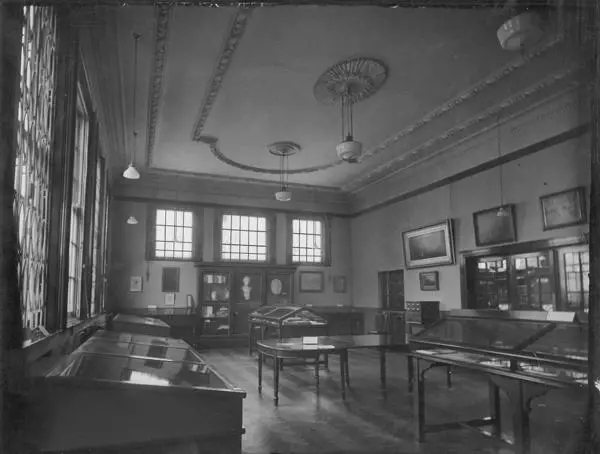
The paintings and artefacts were removed for safekeeping during the war. The house was damaged several times, and repairs and redecoration were only completed in 1952. New showcases were installed, and the collection moved out of the library and into the house. In 1974-75, the London Borough of Camden undertook a restoration programme with the aid of a grant from the Historic Buildings Council.
In 1997 the City of London Corporation assumed responsibility for Keats House. A programme of conservation work began in 1999 and in 2007 the house was awarded £424,000 from the Heritage Lottery Fund (HLF) to allow for the internal restoration of the building. In 2014 Keats House was awarded a grant by Arts Council England to redisplay the house and make the collections more accessible to the public.
Keats House today
Today, Keats House is a registered charity (number 1053381), provided by the City of London Corporation as part of its contribution to the cultural life of London and the nation.